Adoption Program
Adoptions from foster care with help from the Alliance
The Alliance for Children’s Rights, with the help of our pro bono partners, provides free legal services to help families finalize adoptions for children and youth in foster care, as well as access vital benefits and services to support the adoptions and the long-term wellbeing of our community’s young people. We work in partnership with the Los Angeles Children’s Court and the Los Angeles County Department of Children and Family Services (DCFS) to ensure that adoption finalizations go smoothly and are completed as expeditiously as possible. In addition to finalizing adoptions for children and teens, we are the only legal services organization in Los Angeles that helps finalize adoptions for youth ages 18 to 21 in extended foster care, known as “non-minor dependents.”

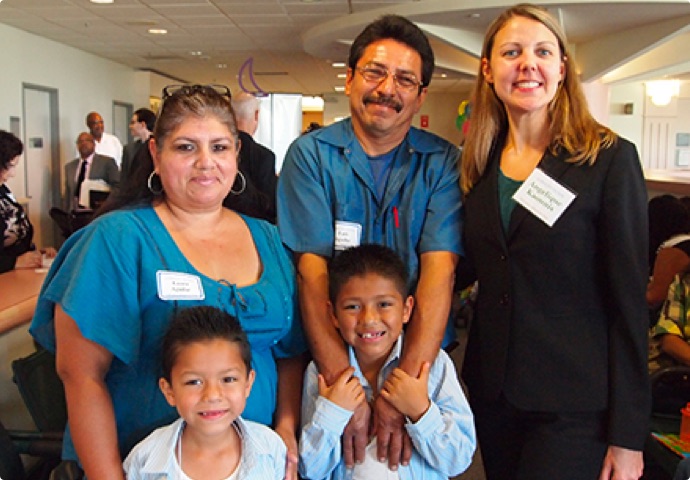
"We are so thankful for the Alliance because they expedited our adoption of these two precious children and made it possible for two siblings to be reunited. We love being parents so much—we get to give them a loving childhood, one that they deserve. "
- JORDAN FAMILY
Over the past 30 years, we’ve helped finalize over 20,000 adoptions (about 28% of all LA County’s foster care adoptions each year) and continue to support hundreds of families each year with our pre- and post-adoption legal assistance. Working in close partnership with the Children’s Court, DCFS, and our network of pro bono attorneys, we were instrumental in completing over 1,000 adoptions through an innovative remote process during the two years that normal operations were disrupted by the COVID pandemic. We also specialize in working with the court and county to remove barriers and expedite adoptions and ensure timely finalizations for all children in LA County foster care – especially older youth who have waited the longest for a forever family.
Foster to Family
Meet Mary
How We Can Help
Working with our pro bono partners, the Alliance provides:
- Education about the adoption process
- Preparation and filing of legal documents needed to finalize the adoption
- Representation at the adoption finalization hearing
- Post-adoption benefits and services
- Help accessing the correct foster care rate and Adoption Assistance Program (AAP) benefits
- Help securing Medi-Cal coverage and resolving denials of coverage
- Special education advocacy
- Mental health advocacy
Getting Started
If you are interested in adopting a child from foster care, you must first contact the Los Angeles County Department of Children and Family Services (DCFS) Foster and Adoption Recruitment Line at (888) 811-1121 or visit their website at: https:/dcfs.lacounty.gov/caregivers/adoption/ for more information or even start an online application; or you may contact a private Foster Family Agency (FFA). You may find a directory of the local Foster Family Agencies at DCFS’ website at https://dcfs.lacounty.gov/about/who-we-work-with/#ffa-partners. DCFS and the FFAs provide orientation meetings throughout the year for those considering foster care adoption. If you are considering becoming a foster or adoptive parent, the first step with either DCFS or an FFA is completing the Resource Family Approval (RFA) process. Once you are approved, you will be eligible to adopt a foster child.
The Alliance offers free legal assistance to prospective adoptive parent(s) to finalize their adoptions after they have completed the RFA process, the child’s parental rights have been terminated by the dependency court, and they have signed the Adoptive Placement/AAP papers with their DCFS and/or FFA social worker. Under protocols with the Children’s Court and DCFS, unless the prospective adoptive parent(s) have chosen to hire a private pay attorney, DCFS will refer foster care adoption cases directly to the Alliance for representation. Once we receive your adoption referral from DCFS, our Adoption Program staff will contact you by phone to initiate our assistance with your adoption and learn more about your family’s specific needs. You may contact the Alliance at (213) 368-6010 and ask for our Adoption Program staff for more information about our services or any questions you may have. [We need to post link to download our “Adopting from Foster Care with the Help of the Alliance” flyer (English and Spanish) here.]
DCFS will refer your case to us or Public Counsel for legal representation. After the Alliance receives the case referral, we will connect with you for a telephone interview to learn more about you and the needs of your family before formally proceeding with the case.
Adoption Days
Families assisted by the Alliance may have their adoption hearing scheduled either on a regular weekday hearing date or on a special designated “Adoption Day” scheduled in partnership with the Children’s Court and DCFS. We help families finalize their adoptions at all the juvenile dependency courtroom locations in LA County, including Monterey Park, Lancaster, Pomona, and Compton. Our goal is always to meet the needs of the families, including when there is a need to expedite the adoption due to the child turning 18 or any other exigent circumstances.
The majority of our adoption cases are finalized on the four designated Adoption Days each year at the Children’s Court in Monterey Park, culminating in the “National Adoption Day” held each year in November on the Saturday before Thanksgiving. These Adoption Days are joyful occasions where the court dedicates its afternoon exclusively to finalizing adoptions, and there is an extra festive atmosphere. The Alliance co-founded National Adoption Day over 25 years ago, and it has grown into an annual event celebrated in over 400 cities in all 50 states.
Important Post-Adoption Information
After your child’s adoption is finalized, you will need to take several important administrative steps to update your child’s official documents and secure your family’s benefits.
Receiving your adopted child’s new birth certificate
After your adoption hearing, your attorney will give you certified copies of your Adoption Order and Adoption Agreement that day. The Adoption Order is your legal proof of the adoption, that you are the child’s legal parent(s), and of your child’s name after adoption. You will also receive a new birth certificate for your adopted child, which will be mailed to you up to six months after the adoption by the California Office of Vital Records or the vital records office in the state where your child was born.
- Birth certificates are prepared by the vital records office in the child’s state of birth. After your adoption hearing, the Superior Court clerk will mail a certified copy of the Adoption Order and Court Report of Adoption (VS44 form) to the California Department of Public Health Office of Vital Records (“Vital Records”) in Sacramento to request issuance of an amended birth certificate for your adopted child.
- The California Office of Vital Records issues birth certificates to children born in California. It can take up to six months from the date of adoption for you to receive an amended birth certificate in the mail from California Vital Records.
- If your child was not born in California, the California Vital Records Office will forward the certified court documents it received to the equivalent vital records agency in the state of your child’s birth for issuance of the child’s amended birth certificate. The state’s vital records agency in some cases will send a letter to the adoptive parents with their application form and required fee to request the amended birth certificate. However, since a letter may not be sent, adoptive parents or their adoption attorney should proactively reach out to the state’s vital records office for information about how to request issuance of the amended birth certificate and any fees.
If you do not receive the new birth certificate or a letter from California Vital Records within six months after finalizing the adoption, you may contact California Vital Records at (916) 445-2684 or by email at AMENDVR@cdph.ca.gov to check on the status. You may also contact the Alliance at (213) 368-6010 and ask for the Adoption Program staff for assistance.
Getting a Social Security Card
To change your child’s name on their Social Security card, or to obtain a new card, you must apply in person at a local Social Security Administration (SSA) office. You will need to complete Form SS-5 (Application for a Social Security Card) and provide original documents proving your child’s identity, age, and U.S. citizenship, as well as proof of your identity and your relationship (i.e., legal parent) to the child.
- Proof of Citizenship and Age: Original U.S. birth certificate, U.S. passport, or Certificate of Naturalization or Citizenship.
- Proof of Identity for the Child: An original document that identifies the child, such as a U.S. passport, the final Adoption Order, a hospital or religious record, or a school identification card.
- Proof of Identity for the Parent: A valid U.S. driver’s license, state-issued identification card, or U.S. passport.
Tip: If the SSA representative refuses to process your application using the Adoption Order (i.e., they are asking that you also provide the child’s birth certificate), politely ask to speak with a supervisor, as federal regulations permit the use of adoption decrees for identity verification.
Adoption Taxpayer Identification Number (ATIN)
If you are finalizing your adoption but do not yet have your child’s Social Security Number in time to file your taxes, you can apply for an Adoption Taxpayer Identification Number (ATIN) by completing IRS Form W-7A. Processing times for the ATIN generally take 4 to 8 weeks.
Applying for a Passport
To obtain a passport for your adopted child, you must submit a certified copy of the U.S. birth certificate showing your name as the adoptive parent, or the official court Adoption Order that specifically states your name as the parent, alongside your own valid government-issued identification.
Frequently Asked Questions
If you have questions or need help during the first six months after your child’s adoption finalizes, contact the Adoption CSW who handled your case prior to finalization. If your adoption has been finalized for more than six months, contact the Los Angeles County Department of Children and Family Services (DCFS) Post Adoption Services (PAS) Unit at (800) 735-4984. A PAS social worker will process AAP inquiries, assist with needed referrals, and handle other concerns or questions. You may also call Alliance for Children’s Rights at (213) 368-6010.
If you have not received an AAP check, or have a change of address, call the AAP Hotline
at (800) 697-4444. Also call this number when you are having problems like your child’s MediCal card is not working.
You are automatically sent one (free) certified copy of your child’s new birth certificate after the adoption is final, which is issued by the California Department of Health Services Office of Vital Records. However, the “automatically” part can take from three to six months. If you’ve been waiting at least three months, you can call the Office of Vital Records at (916) 445-2684. You can also visit their website at www.cdph.ca.gov.
The county clerk of the superior court granting the adoption is required to complete the Court Report of Adoption (VS44) and send a certified copy of the Adoption Report and the Adoption Order to the California Department of Health Services, Office of Vital Records. The new birth certificate will be prepared by the vital records office in the child’s state of birth. If your child was born in another state, the California Office of Vital Records will forward the Report to the vital records office in the child’s state of birth so they can prepare the new birth certificate. If your child was born in another state, you may be required to pay a nominal fee for issuance of the new birth certificate. (The California Office of Vital Records’ $20 registration fee is waived for foster care adoptions for children born in California.) If your child was not born in California and you have not received the birth certificate, call The Alliance or the pro bono attorney who assisted you with the adoption and we can contact the vital records office in the state where your child was born.
At your local Social Security Office, complete an Application for a Social Security Card (Form SS05). You will need to show them original documents proving your child’s U.S. citizenship, age, and identity. You will also need to show them documents proving your identity and your relationship as parent of the child (as you are signing the application on the child’s behalf). If your child is age 12 or older, h/she must appear for an interview at the Social Security office, even if a parent or guardian will sign the application on the child’s behalf.
- For proof of U.S. Citizenship, the Social Security office can accept only certain documents. These include a U.S. birth certificate, U.S. consular report of birth, U.S. passport, Certificate of Naturalization or Certificate of Citizenship.
- For proof of your child’s Age, you must present your child’s birth certificate if you have it. If not, the Social Security Office can consider other documents, such as your child’s passport, to prove age.
- For proof of your child’s Identity, the Social Security office can accept only certain documents. These include a U.S. passport, an Adoption Order, a hospital record, a religious record, or school identification card.
- For proof of your identity, the Social Security office will ask to see your U.S. driver’s license or identification card, U.S. passport, or they will accept other documents such as an employee ID card, school ID card, marriage document, health insurance card, U.S. military ID card, or adoption order.
All documents must be either originals or certified copies. They may use one document for two purposes (such as use your child’s passport as proof of both citizenship and identity; or, may use your child’s birth certificate as proof of age and citizenship). However, you must provide at least two separate documents.
For proof of your child’s U.S. citizenship, age and identity, in lieu of the new birth certificate, you can show the Social Security office your child’s U.S. passport if h/she has one. If not, you can show your Adoption Order (ADOPT-215), which includes the information regarding the child’s name, date of birth and place of birth. Along with that, you should show your Adoption Agreement (ADOPT-210), which includes your name(s) as the adoptive parent(s), your child’s original birth name, and your child’s new name after adoption. If you have a copy, you can also show the child’s original birth certificate for proof of U.S. citizenship, along with the adoption documents. Ask for a supervisor when you go to the Social Security Office, who may have more knowledge and authority to approve your application with the Adoption Order as your proof. Also, you may contact Cynthia Billey at The Alliance who can provide you a letter to take with you to the Social Security office requesting that they accept the Adoption Order as proof of the child’s citizenship, age and identity.
An ATIN is an Adoption Taxpayer Identification Number issued by the Internal Revenue Service (IRS) as a temporary taxpayer identification number for the child in a domestic adoption where the adopting taxpayers do not have and/or are unable to obtain the child’s existing or a new Social Security Number (SSN) in time to file their tax return. The ATIN is to be used by the adopting taxpayers on their Federal Income Tax return to identify the child while the final domestic adoption is pending or after the adoption is finalized. Thus, for example, if you are unable to obtain an SSN for your adopted child due to the long processing time for issuing new birth certificates, you may apply with the IRS for an ATIN.
To apply for an ATIN, complete IRS Form W-7A, Application for Taxpayer Identification Number for Pending U.S. Adoptions. This is available at https://www.irs.gov/pub/irs-pdf/fw7a.pdf or by calling 1-800-829-3676. It will generally take 4 to 8 weeks to get an ATIN once the IRS receives a completed Form W-7A. You may be able to use an ATIN on your tax return to take the following tax benefits based on the child: dependency exemption, credit for child and dependent care expenses, adoption credit, child tax credit. Please consult your accountant or a tax preparer for advice in your individual situation. You may call the IRS Information Hotline toll free at (800) 829-1040, or the Austin Service Center at (737) 800-5511 (not a toll-free number).
To apply for a passport for a child under age 14, adoptive parents must fill out Application For A U.S. Passport Form DS-11 (https://travel.state.gov/content/travel/en/passports/how-apply.html) and submit it to a passport acceptance agency along with proof of the child’s U.S. citizenship and evidence of the child’s relationship to the parents/guardians. For proof of citizenship, you will need to submit either a certified U.S. birth certificate or a previous fully valid U.S. Passport. For proof of relationship, you will need to submit either a certified U.S. birth certificate (with parents’ names) or Adoption Order (with adopting parents’ names). Each parent must submit their own identification (i.e., valid driver’s license passport, etc.) and both parents must appear together and sign the application form. Go to https://travel.state.gov for more information.
As with applying for a Social Security card, if you have not yet received your child’s new certified birth certificate, you can try submitting the Adoption Order along with the Adoption Agreement or DCFS Consent and Joinder to the passport agency as proof of the child’s U.S. citizenship as well as your relationship to the child. If you have a certified copy of the child’s original birth certificate, you can submit that along with the Adoption Order and Adoption Agreement showing a change in the child’s name after adoption. The Adoption Order contains the child’s name, adoptive parents’ name(s), child’s date of birth, and place of birth, all sufficient to prove the child’s U.S. citizenship and the parents’ relationship to the child. However, it is possible that the passport agency will not accept the Adoption Order alone for purposes of proof of citizenship and will require either the original or new birth certificate or a previous valid U.S. passport.
Yes. Families who adopt a child with special needs from foster care can claim a Federal Adoption Tax Credit without needing to incur or document any adoption expenses. The per-child adoption tax credit for adoptions finalized in 2019 is $14,080. The 2019 adoption tax credit is a non-refundable credit, meaning the credit is an amount you can subtract dollar-for-dollar from the taxes you owe, thus reducing your tax liability. For more information, please consult a tax attorney, tax preparer, accountant, or the IRS (800-829-1040 or www.irs.gov, or www.irs.gov/taxtopics/tc607.html). More detailed information on the adoption tax credit is also available at https://www.nacac.org/help/adoption-tax-credit.
To qualify for the credit without documenting expenses, families must a) have adopted a “child with special needs” from foster care, and b) have a modified adjusted gross income of a certain level.
- Does my child have special needs? Children who are hard to place for adoption – older children, children of color, sibling groups, and children with medical conditions or disabilities – are often determined to have special needs. Generally, this means that if a child receives adoption assistance program (AAP) benefits, the adoption assistance agreement is evidence that the state or county has determined that the child has special needs. These children are eligible for the full tax credit without documenting expenses.
- Are we financially eligible for the credit? How much, if any, of the credit you can use is based on your income. For 2019, families with a federal modified adjusted gross income below $211,160 can claim full credit. Those with incomes above $251,160 cannot claim the credit. Those with incomes from $211,160 to $251,160 can claim partial credit. Adoptions from previous years had different income levels.
To claim the credit, you need to complete IRS Form 8839 in addition to filing IRS Form 1040 or Form 1040A. You can find Form 8839 at www.irs.gov/pub/irs-pdf/f8839.pdf or by requesting it from 800-829-1040. You can claim the credit in the year the adoption finalized. The IRS no longer requires you to include a copy of your Adoption Order and Adoption Assistance Program (AAP) Agreement (or a copy of the state determination of special needs) with the Form 8839.
Note about refundable adoption tax credit. The Patient Protection and Affordable Care Act of 2010 made the adoption tax credit refundable for tax years 2010 and 2011 only. When a credit is refundable, individuals can get the credit as a tax refund even after your tax liability has been reduced to zero.
Families who finalized the adoption of a foster child with special needs in 2010 and 2011 only should carefully read any instructions issued by the IRS to determine how the refundable tax credit will actually work in their situation.
Families who adopted from 2005-2009 may be able to benefit from the refundable credit because credits from those years can be carried forward until 2010. For more information, go to www.nacac.org/taxcredit/taxcredit.html.
You need to respond to the notice immediately. The notice encloses the state AAP 3 form that DCFS is required to send you every two years after the AAP agreement was signed to recertify your continued need for AAP benefits. You must complete and return the AAP 3 Form immediately. If you do not return the AAP 3 form to DCFS within two weeks of the date it was mailed, DCFS may take action to terminate your AAP benefits.
You should check the appropriate boxes indicating that you are legally responsible for the support of the child, and that you are supporting the child; and indicating either that you continue to need AAP benefits for the child at the current level, or that you are requesting an increase in the AAP benefit because the needs of your child have changed.
If your child’s needs have changed and you want to request an increase in the AAP benefits, you may check the appropriate box and complete Section I of the form indicating the needs of the child and circumstances of the family. Include any documentation you have showing the child’s condition(s) and needs.
Make sure to sign and date the form. If you have any questions about the notice you have received in the mail from DCFS, you should call the DCFS Post-Adoption Services (PAS) Intake Line at 800-735-4984 or call Alliance for Children’s Rights at (213) 368-6010 for assistance.
Yes, adopting parents can at any time request a reassessment of the amount of the child’s AAP benefits based upon reassessment of the child’s needs, i.e., because the child’s needs have changed (for example, the child has a new diagnosis or condition and/or new treatment or services). You should call the PAS Intake Line at 800-735-4984 to initiate a request for reassessment of AAP benefits. You may also request a reassessment of AAP benefits at the time you receive the bi-annual AAP recertification notice from DCFS (see question above).
AAP benefits terminate on your child’s 18th birthday, even if your child is still enrolled in high school. Your child’s AAP benefits may be extended to age 21, if your child has a documented mental and/or physical disability for which s/he is receiving services from a licensed professional that warrants the continuation of assistance to age 21. If you think your child does qualify for an extension of his/her AAP benefits past their 18th birthday, call the PAS Intake line at 800-735- 4984 to request that DCFS re-assess your child’s needs for continuation of benefits beyond the age of 18. You should call at least three months prior to your child’s 18th birthday.
In addition, your child’s AAP benefits may be extended to age 21 under the specific circumstances of AB 12. Under this California law, a child is eligible to receive AAP benefits to the age of 21 if the initial AAP Agreement was signed when the child was at least 16 years of age and the child meets one of the following five AB12 participation criteria:
- 1) Completing a high school or an equivalency program; or
- 2) Enrolled in a post-secondary or vocational school; or
- 3) Participating in a program or activity that promotes or removes barriers to employment; or
- 4) Is employed at least 80 hours per month; or
- 5) Is incapable of participating in 1 through 4 above, due to a mental or physical disability.
If you think your child does qualify for an extension of his/her AAP benefits past their 18th birthday based on AB12, call the PAS Intake line at 800-735-4984 to request that DCFS extend the AAP benefits beyond the age of 18. You will need to provide DCFS with documentation that your child meets the criteria (i.e., provide copy of the child’s initial AAP agreement and documentation of meeting one of the criteria outlined in 1 through 5 above. You should call at least three months prior to your child’s 18th birthday.
You may also call the Alliance at (213) 368-6010 for assistance with requesting continuation of AAP benefits with DCFS. If DCFS approves a continuation of your AAP benefits to age 21 under either of the circumstances explained above, you will sign a new AAP agreement with DCFS setting forth the AAP rate and extending the effective date to the child’s 21st birthday.
In addition, your child may be eligible for AAP benefits to continue after he/she reaches age 18 under the specific circumstances of AB 12. Under this California law, a child is eligible to receive AAP benefits after reaching the age of 18 if the initial AAP Agreement was signed when the child was at least 16 years of age and the child will be age 18 on or after January 1, 2012; and one of the following five participation criteria is met:
- Completing a high school or an equivalency program; or 2.
- Enrolled in a post-secondary or vocational school; or 3.
- Participating in a program or activity that promotes or removes barriers to employment; or 4.
- Is employed at least 80 hours per month; or 5.
- Is incapable of participating in 1 through 4 above, due to a mental or physical disability.
If you think your child does qualify for an extension of his/her AAP benefits past their 18th birthday based on AB12, call the PAS Intake line at 800-735-4984 to request that DCFS extend the AAP benefits beyond the age of 18. You should call at least three months prior to your child’s 18th birthday.
Yes, there is funding available from AAP that will cover the cost of your child’s stay in certain Residential Treatment Centers (RTC) if that RTC meets specific qualifying guidelines. You may call the PAS Intake Line at 800-735-4984 for more information. Your entire AAP benefit will be forwarded to the RTC during your child’s stay at the RTC and will be reinstated to you once he/she returns to your home/care.
Children who were in foster care and adopted at age 16 or older are eligible for the LA County DCFS Independent Living Program (ILP) services as if they were “emancipating” from the foster care system. The ILP Program supports current and former foster youth ages 16 – 21 in successfully transitioning to adulthood, and provides critical resources in the areas of life skills training, college readiness and financial aid, educational support, employment and housing. Such services could include high school graduation expenses; education-related and work-related costs; financial aid workshops; housing assistance; job placement and training; life skills training; reimbursement for some physical and mental health services costs that are not funded by Medi-Cal, including costs for classes or services related to parenting skills, nutrition, drug and alcohol use. At times, some of these services and resources may not be available due to limited funding. The ILP program receives a set budget every year from state and federal government sources. Please be aware that services and resources are distributed according to need and not as an entitlement. For more information, call the ILP Program at (213) 351-0100 or see their website at www.ilponline.org
If you are in the process of adopting a child who will be age 16 or older at the time of the adoption finalization, the child’s social worker and/or your DCFS adoption worker should refer the teen to the ILP Program if the teen and the prospective adoptive parent(s) are interested in these benefits. An ILP Coordinator will be assigned to develop a written plan for services, and to help the teen access services. You may also call the Alliance at (213) 368-6010 for assistance.
Yes, in 2013, California created a new type of adoption, called “non-minor dependent adoption,” that allows young adults between ages 18 and 21 that remain in the county’s AB12 extended foster care program to be legally adopted and to receive Adoption Assistance Program (AAP) benefits until they reach age 21.
The adoption process for a non-minor dependent (or “NMD”) is different from the process for a foster care adoption for a minor child. NMD adoption is based on mutual consent (i.e., both the prospective adoptive parent(s) and the non-minor dependent must mutually agree to the adoption and sign an agreement). Termination of birth parents’ rights is not required. Also, while DCFS is required to prepare an NMD home assessment and write an adoption report to be submitted to the court, RFA approval is not required for non-minor dependent adoption. A petition for adoption of non-minor dependent, agreement of adoption, and order of adoption must be filed with the superior court, along with DCFS’ adoption report.
- If you or a non-minor dependent in your care are interested in NMD adoption, you or the non-minor dependent may initiate the process by communicating your intent either verbally or in writing to the social worker, the NMD’s attorney, or during a review hearing in the NMD’s juvenile dependency case. For more information or legal assistance with completing an NMD adoption, you may contact the Alliance at (213) 368-6010 and ask for the Adoption Program. To date, working in partnership with the Children’s Court and DCFS, the Alliance has completed over 75 non-minor dependent adoptions.
No, in a foster care adoption, the dependency court terminated the parental rights of the child’s biological parents, thus “legally freeing” the child for adoption. This terminates all rights of the birth parents, including custody of or visitation with the child. Once the Adoption Order is granted by the superior court, all rights over and responsibilities for the child are exclusively vested in the adoptive parent(s). Any prior orders of the dependency court relating to visitation of the child’s birth parents are terminated and no longer in effect after the adoption. Any contact with the child’s birth relatives, including the biological parent(s), siblings or other relatives after the adoption is a decision in the sole discretion of the child’s adoptive parent(s).
California law does permit adoptive parents to enter into voluntary “post-adoption contact agreements” with birth relatives of the child. (Family Code § 8616.5) However, it is important to understand that such post-adoption contact agreements are strictly voluntary; they cannot be ordered by the court or required by the county child welfare agency, the minor’s attorney, or any other party. They will only work where all parties entering into such an agreement do so willingly and with the full intention of working together. While the law does allow the minor’s attorney or social worker to convene a meeting (after termination of parental rights and before adoption finalization) with the child, sibling(s) of the child, prospective adoptive parent(s), and a facilitator for the purpose of exploring whether the parties are open to a voluntary post-adoption contact agreement with siblings or other birth relatives, the prospective adoptive parents cannot be required to agree to enter into a post-adoption contact agreement following the meeting. Such agreements should not be pushed on any of the parties by social workers, attorneys, or the courts.
Despite having wonderful adoptive families, many children who are adopted desire to search for their birth families especially after turning 18. Most adoption support groups encourage adoptees to include their adoptive family in their search. Sometimes the adoptee does not realize that their parents may (or may not) possess information about the birth family. Many adoptive parents want to emotionally support their adult child as they navigate through the search process. Some advice to adoptive families is to support the adoptee in doing their search, help them understand that it’ s perfectly normal to want to know about every aspect of their background, and acknowledge that they are not looking for parental replacements but for the very beginning of their story.
While a child’s dependency court case is open (i.e., before finalization of the adoption), if a birth parent tells their child’s social worker that they would like to have contact with their child after the child reaches adulthood, the birth parents may submit a notarized Consent for Contact form (AD 904) and have it placed in their child’s case file. If, after the child turns 18, he or she wants the Los Angeles County Department of Children and Family Services Post–Adoption Services (PAS) to assist them in locating and reuniting with their birth parents, he or she can call the DCFS PAS Intake Line 800-735-4984 and submit the same form. This form allows the PAS worker to disclose the name and phone numbers of the birth parent(s) to their adult biological child and vice-versa. The form is available on-line at http://www.cdss.ca.gov/cdssweb/entres/forms/English/AD904.PDF.
DCFS’ PAS Unit is also able to facilitate reunions between sibling adoptees who have reached the age of 21 years. If an adoptee wants assistance from the DCFS PAS Unit in reuniting with their sibling(s) who were also adopted, they must submit a notarized Waiver of Rights to Confidentiality for Siblings form (AD 904A) to PAS. Once PAS receives these notarized forms from all parties, the PAS worker can facilitate a sibling reunion. These forms are also available on-line at http://www.cdss.ca.gov/cdssweb/entres/forms/English/AD904A.PDF
Adoption Tax Credit
Yes. Families adopting a “child with special needs” can claim the Federal Adoption Tax Credit for each child they adopt in the year the child’s adoption becomes final, without having to incur or document “qualified adoption expenses.” Basically, a “child with special needs” is a U.S. foster child who receives monthly Adoption Assistance Program (AAP) benefits. Also, if you adopted a child in California, you can also claim a credit for 50% of the cost on your state income tax return.
Who is eligible for the federal adoption tax credit?
Eligibility for the federal adoption tax credit is based on income and other eligibility requirements. In addition, the amount of the adoption tax credit, the income requirements, and whether the tax credit is refundable or non-refundable change from year to year based on federal legislation. Families are encouraged to review adoption tax credit information from the Internal Revenue Service (IRS) (1-800-829-1040 or www.irs.gov) and/or consult their tax preparer. Another resource is www.wearefamiliesrising.org/resource/tax-related-adoption-assistance/.
No, the adoption tax credit is typically a one-time credit per adoption, though unused portions may carry forward for several years. Families may claim expenses the year after you incur or pay them if the adoption is still in progress and not final. Families are encouraged to review adoption tax credit information from the Internal Revenue Service (IRS) and/or consult their tax preparer.
To claim the credit, adoptive parent(s) must file IRS Form 8839 (Qualified Adoption Expenses) with their income tax return. The amount of the credit is based on the year the adoption finalized. For example, for adoptions finalized in 2025, the maximum adoption tax credit is $17,280 per eligible child. How much of the adoption tax credit you can claim is affected by your income. Families with modified adjusted gross incomes of $259, 190 or less can claim the full credit. Families with modified adjusted gross incomes between $259,190 and $299,190 may only claim a partial credit. Those with incomes of $299,190 or more cannot claim the credit. Beginning in 2025, a portion of the adoption tax credit – up to $5,000 – is refundable, which means that you can receive a portion of the credit as a direct payment (tax refund) regardless of whether you owe or pay any taxes for that year. Any remaining credit beyond the refundable portion can be used to reduce your tax liability to zero. Any unused, non-refundable portion of the credit can be carried forward for up to five subsequent tax years.
The county clerk of the superior court granting the adoption is required to complete the Court Report of Adoption (VS44) and send a certified copy of the Adoption Report and the Adoption Order to the California Department of Health Services, Office of Vital Records. The new birth certificate will be prepared by the vital records office in the child’s state of birth. If your child was born in another state, the California Office of Vital Records will forward the Report to the vital records office in the child’s state of birth so they can prepare the new birth certificate. If your child was born in another state, you may be required to pay a nominal fee for issuance of the new birth certificate. (The California Office of Vital Records’ $20 registration fee is waived for foster care adoptions for children born in California.) If your child was not born in California and you have not received the birth certificate, call The Alliance or the pro bono attorney who assisted you with the adoption and we can contact the vital records office in the state where your child was born.